


From Archival Sources
Damir Stanić, PhD was born in 1983 in Zagreb. Since 2011 he has been working in the Croatian State Archives in Zagreb, where he worked on and researched the records connected with the history of the Military Frontier – especially the Bihać Frontier, Slunj and the surrounding area. Since his mother was from Pavlovac (surname Štajduhar), his interest for the Slunj area does not come only from scientific curiosity, but also from a strong personal and emotional dimension. It is that very connection that motivates him to write popular scientific texts based on authentic archival sources and historical experience of people from the Slunj area, alongside his historiographic work.
His work in the column Iz arhivskih vrela (From Archival Sources) is the result of serious scientific research and popular essay writing endeavour to reveal to the local community and wide public the previously unknown details from the rich history of the Slunj area.
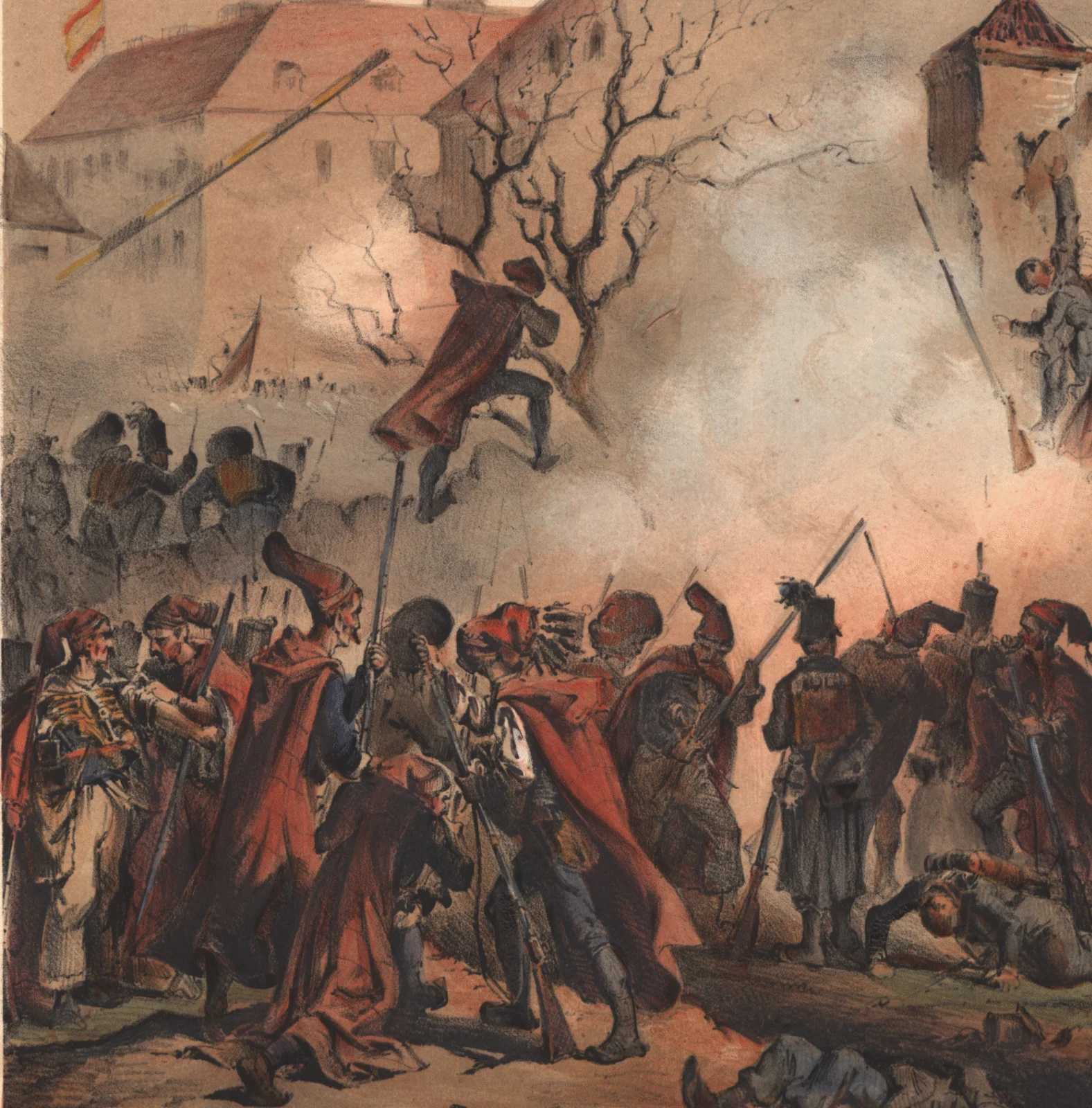
Croatian State Archives, HR-hda-903. Graphic Collection, inv. No. 1268. Croatian Frontiersmen in the Street Fights in Wien. Also showing the wounded Frontiersmen.
Matija Lovrić – Longtime Slunj Teacher and Organist in the Church of the Most Holy Trinity
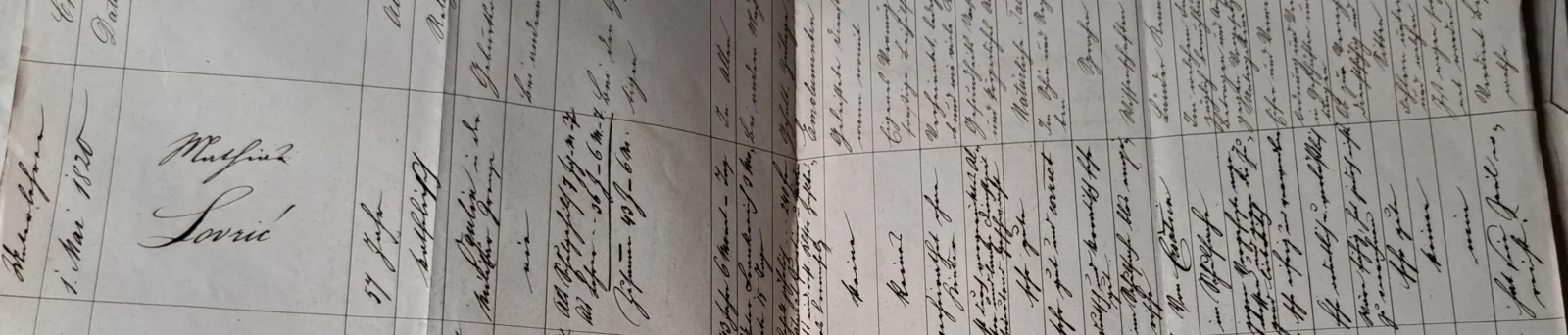
Croatian State Archives, HR-HDA-442. The Slunj Frontier Regiment. Personal and Official Data on Matija Lovrić.
This text is a small contribution and maybe even a motivation for further investigation of interesting and worthy residents of Slunj and the Slunj area throughout history. I will look back on one of them – longtime Slunj teacher and church organist Matija Lovrić. His name and work are probably not known to the current population, but he was a respectable member of the local community. Enough sources and records are kept about him and they enable us to present his short biography and work in the local community.
All the data about Lovrić come from several sources compiled in 1856 and 1857, although those are not the only records that mention his name. Lovrić was born in a Catholic family in Ogulin in 1799 and up to 1856 he spent incredible 43 years and six months in the school system – seven years as a school assistant and over 36 years as a teacher. He started his career in education when he was very young, only 14 years of age in 1813, during the time of the French administration. For three months and 15 days, he worked as a school assistant in the area of the Ogulin Frontier Regiment. He stayed in that position until 13 April 1820 when he became an assistant teacher in the same regiment. At the end of October of the same year, he was transferred to Slunj. In the trivial school in Slunj, he remained for the next 36 years, until 1 October 1856 when he reached his well-deserved retirement.
At that time, in his advanced age, Lovrić asked for retirement because of his bad health. The regiment doctor examined him and wrote in his medical history that he was ‘of a stout physical build’, after recovering from a fever in 1839 he contracted asthma and chronic breathing problems and eight years earlier he had started having vision problems. When reading and writing he had to wear glasses, but even with glasses he was able to only read for a short while because he suffered from blurry vision and headaches. Lovrić himself wrote that he had been working without an assistant for decades and that he had to teach 80 to 110 children every day for eight hours and he was incapable of doing that any longer. The doctors’ expertise confirmed that he was in bad health and he was given the status of ‘real invalid’ and granted pension due to ‘physical weakness’ and asthma. The record shows that his physical condition was “seriously weakened due to old age and long-term service”.
Although he spent his whole life surrounded by children, the records show that Lovrić and his wife (whose name is unfortunately not mentioned) had no children nor did he own any significant property. In his personal file, his professional work and expert profile are described in much detail. In the column ‘natural talent’ it is written that he was ‘very good’ and his penmanship and orthography are valued as ‘very good and correct’. He could write, read and translate Croatian and German languages and his school knowledge is described as ‘purely empirical’. As far as his knowledge of countries went, it is stated that he was competent for Croatia, but not for general geography. He behaved appropriately, was kind to young people, hard-working and diligent in his work, responsible and reliable, of good manners and without faults. At the end of the document, there is a column that says “Did he earn a promotion and which one” and the command of Lađevac Company wrote the following sentence, “he has achieved his (life or professional author’s remark) goal”.
For several decades, Lovrić also had another reputable and important duty in Slunj – he was the organist in the Church of the Most Holy Trinity. We do not have to specify how important the organist is during the holy mass and other church ceremonies so organists were even more reputable in the past than they are today. He enjoyed additional good reputation based on the fact that he was the only organist in the Company area and maybe ever wider. It is not written where Lovrić received his musical education, but we do know that he was a church organist for more than 35 years, receiving a monthly pay of 4 forints. When his health became a serious obstacle for the continuation of playing music, the question of his successor arose. Lovrić himself never taught anyone to play the organ because he was not obliged to do that and he did not have the necessary pedagogical skills. In addition, not a single state or county teacher who could play the organ existed or was able to take on that duty. We still have to investigate how that story ended.
Surely, more records about Lovrić will emerge. If that happens, we will be able to update the biography of a man, now forgotten, who once had responsible roles and unmistakable reputation in the Slunj society. His status is also visible in the fact that he was granted a decent pension without any problems and that the records do not say anything negative about him. What is more, it is very clear that Lovrić had the respect deserving of a person who taught the youth of the Slunj area for decades, despite all the problems, which both he himself and the school system were facing at the time. Such individuals deserve to be written about and I believe that further research will show many similar reputable workers from the past. And we can wonder, what would the command write about us at the end of our careers? Would we be as lucky as Lovrić was, that someone would say “achieved their goal” about us? Certainly, we can and must aspire to that.
The World of the Military Frontier
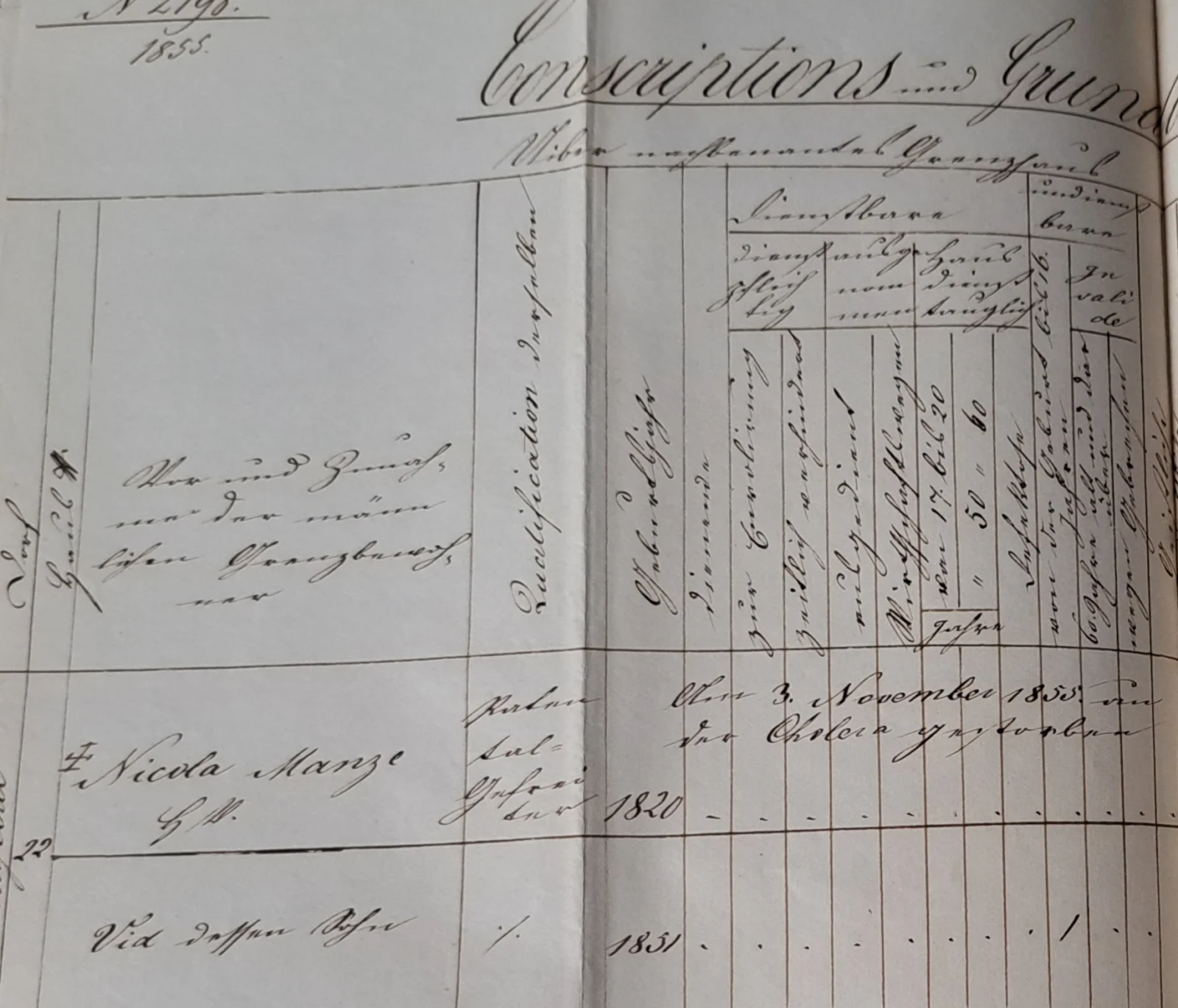
Croatian State Archives, HR-HDA-442. The Slunj Frontier Regiment. Data on the deceased Nikola Mance and his son Vid.
Krajiški je svijet bio vrlo siromašan. Naravno, kao i u svakom d
Life in the Military Frontier was very poor. Naturally, just like in any other society, there were big differences between various Frontier cooperatives and families; some were prosperous, others were of a humbler financial status, yet others were on the very edge of poverty or even more often, on the other side of the threshold of serious destitution. Modern people have difficulties even imagining what the past reality looked like. Life was extremely hard, agriculture was rudimentary, mortality was high, illiteracy was omnipresent. Every day was literally a small fight in the great war with death. Men played the main role on the basis of physical strength, additionally fortified by their dominant role in society in comparison with women. Although there were some widows who acted as heads of families, it was a world typically ruled by men. When a family lost a man, and there were no other working hands to replace him, the family would be stuck in an existential crisis.
As a consequence of the war on the territory of the Military Frontier and/or the imperial wars of the Habsburg family all over Europe, the Frontier society had an astounding amount of people with some degree of physical disability. At the end of the 18th and the beginning of the 19th century, about half of the male population in the Frontier suffered from some form of disability. The injured were put into two categories; ‘half-invalids’ and ‘real invalids’. Only a small number of ‘real/complete invalids’ received some kind of disability allowance, while other were not that lucky. Those with a lesser degree of disability were not exempt of house work nor agricultural work and they were also serfs, providing forced labour for the landowners. Disability was a consequence of a wound and/or illness, which permanently impaired the health of an individual, often making one an even easier prey for the eternal hunter – Death. It was the hardest for the small families in which the only man suffered from a disability, regardless of whether he received disability allowance or not. If the only man in the house was disabled and had the allowance, the survival of the whole family would depend on his allowance and his health condition. If he died, the family would lose their head of the house, their man and their financial support.
One such case happened with the death of Nikola Mance from Donji Lađevac (house number 22). He earned his disability in the dramatic and worldly famous events of the revolutionary 1848, in no less than the attack of the Sophienbrücke (Sophie Bridge) in Wien. He showed great courage, which fate reimbursed with a wound in his left upper arm and permanent disability and the king awarded him a gold medal for courage and the allowance that went with it. Unfortunately, Nikola did not live long – he died on 3 November 1855 when he was 35 – from cholera, leaving behind his wife Ana and two little children, four-year-old Vid and one-year-old Tereza. After his death, his disability allowance stopped arriving. The record shows that, despite the meagre country support, they lived an extremely poor life and were amongst the poorest in the Lađevac Company. After her husband died, Ana was so poor that she was unable to pay for statutory emblems required for the application asking for further financial support for her and alimony for the children. The commanders of the company wrote this down. Their destituteness is visible from the fact that her application was supported by the Lađevac Company and the command of the Slunj Frontier Regiment – institutions which were generally notorious for their military and uncompromising strictness and sometimes bureaucratic frigidity.
How this sad story ends, we do not know. I believe that everyone reading this story hopes that the mother and children survived the challenges and that their fate turned and luck smiled upon them. However, those dealing with history know, and the others can sense instinctively, that that was usually not the case. Primarily, history is a horizon for suffering and fighting for sole survival. That very discovery and feeling should instil in us a respect for our ancestors, who, despite the constant fight with the quicksand of existence, courageously kept their head above the surface in order to give us the possibility of living a life that is, unthinkable for them, of a much better quality. Therefore, in their honour, we live!
Please, I Do Not Want My Child to Attend School
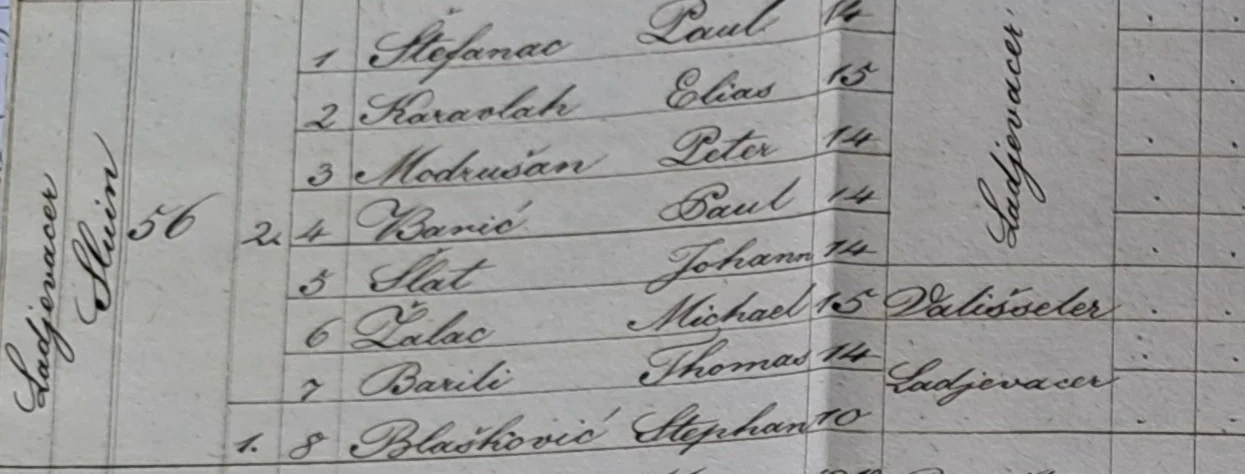
Croatian State Archives, HR-HDA-442. The Slunj Frontier Regiment. Names, age and origin of pupils who left school in Slunj.
In the past, a small number of children attended school and the Military Frontier situation was not any different. Most of the resident were illiterate and uneducated, and that part of social life was not questioned. Naturally, schools existed – at first only those presided by priests or members of church orders and later various kinds of state schools (public schools, German schools etc.) as well. Only a small number of children attended those schools, and mostly boys. Furthermore, from today’s perspective, it is unusual and maybe even hard to understand that that small number of children often became even smaller because families asked for children not to be enrolled in schools and those who were already enrolled to leave school. The reason for that was very prosaic – attending school was a financial drain for the Frontier households and the absence of children was greatly felt in everyday house and cooperative chores. The awareness about the importance of education was not yet developed enough. If it existed, it was second to existential challenges.
Talking about school education in the area of the Slunj Frontier Regiment, there are many sources from the 19th century. For example, in 1857, there were 18 villages and three parishes with 4255 residents in the area of Blagaj Company. Due to the rocky ground and bad soil, the houses are scattered so only some cooperatives are less than an hour of walking from the newly-built schools in Veljun and Cvijanović Brdo. Therefore, only 40 to 50 children are able to attend classes in those schools. Even during good years, the cooperatives were unable to provide enough food from their arid fields and the counties were too poor to provide for two teachers even though the state gave the teachers firewood and building materials. The situation was very difficult. The elders of the Blagaj Company submitted an application requesting for the classes to be held only in the German school in Veljun and – instead of classes in the other two public schools – only church classes on Sundays and church holidays in some parishes to be held until the financial situation of the Blagaj Company improves. In other words, the local elders asked for classes in the public schools to be suspended temporarily and that only the more elite German school continues with work because the future military and government staff are educated there. For the purpose of education of such staff, some pupils would often be transferred from public to German schools.
For example, records from the military government in 1846 show that when it comes to attending the German schools, only talented children under the age of nine should be transferred from public to German schools and if they are not successful in their first year, they should be allowed to leave school. However, it should be said that the military government demanded that even those children who left school should attend classes on Sundays and church holidays until the age of 15. Elementary schools had to be filled with children aged six to seven, of both genders, and they took special care that the number of pupils did not decrease. As was already mentioned, the talented children were to find their place in the education system and enabled to transfer to German schools, where the military and government staff for the Military Frontier was educated. The number of pupils in the German schools in 1846 was not sufficient – for instance, the Blagaj Company had only one boy enrolled in the German school, which could potentially result in lack of literate people ready for service in the military and the government. So, it was necessary to transfer a certain number of children from public to German schools.
As far as the children leaving school are concerned, another source from 1846 says that eight children left the public school in Slunj; ten-year-old Stjepan Blašković from the first grade, fourteen-year-olds Pavle Barić, Tomas Barili, Ivan Šlat, Petar Modrušan and Pavle Štefanac from the Lađevac Company and fifteen-year-olds Ilija Karavlah and Mihael Žalac from the Vališ Selo Company, all from the second grade. Tomas Barili left school because he started learning a craft (it does not say which) and the rest of them started working ‘in the office’. In the Slunj public school, only 48 children remained. Then, it was emphasised again that of the children attending school in Slunj (from the Lađevac, Vališ Selo and Blagaj Companies), only the most talented could be sent to German schools. The Lađevac Company, to which Slunj belonged, should educate as many children of both genders as the school space allowed.
These records show that in the Frontier structures, there was an awareness for the importance of educating children, even if it was primarily motivated by the needs of the military and government service. Maybe this little memorial of the former pupils from Slunj and the surrounding area, who left school because of other needs, will raise awareness for the fact that the reaches of modern life – and education as well – are not self-explanatory and ever present. They have their own recent and complicated history, which needs to be understood and respected.
From Pavlovci to Hrtkovci / A Passenger with a Narrow and Bright Face
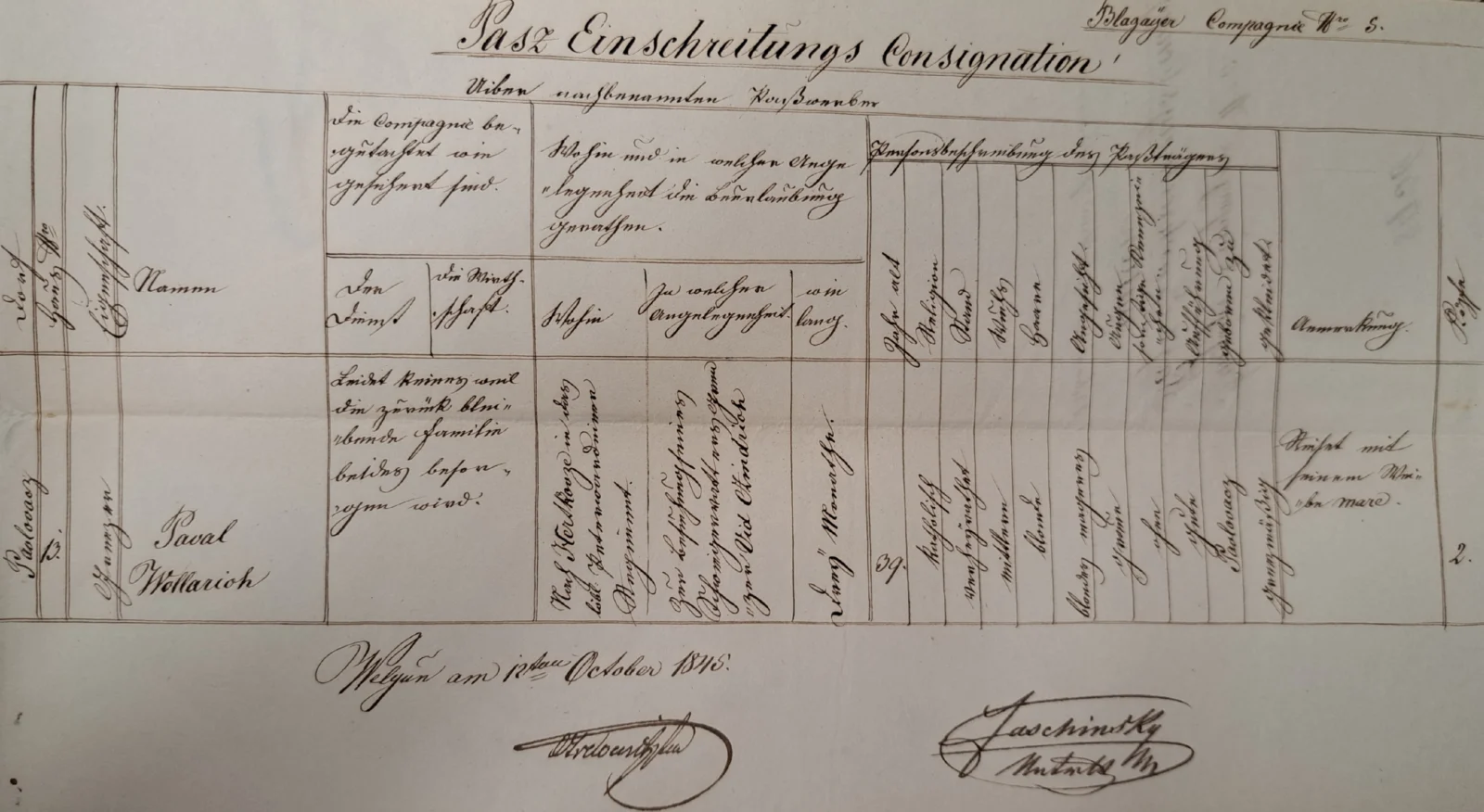
Croatian State Archives, HR-HDA-442. The Slunj Frontier Regiment. Pavao Volarić’s Permission for Travelling with personal data.
Croatian history and, sadly, present are largely labelled by migration. Compulsory and voluntary, inner and external migration – those in which individuals, families and even whole communities went to the local neighbourhood as well as across the pond – are the integral part of our dynamic historical experience. The Ottoman attacks, epidemics, climate change, failed crops, backward rural homesteads, grapevine disease etc. mercilessly forced our people from their hearths towards new horizons, new sociocultural spaces and political frames, where – it should be emphasised – they often had better chances of ensuring their livelihood than in their old homeland. One of the most important migration routes was the one towards Slavonia and Vojvodina (primarily Srijem), where many people from the Military Frontier area migrated.
The migration of the Croatian population into Srijem was a process of many centuries, which unfolded in stages, both massive and capillary. Families, parts of cooperatives and individuals set way towards the Pannonic plains. The most common reason were the harsh conditions in the old area, often overpopulated, arid and – even though today it is hard to understand this part – very poor. Sometimes it was not easy to migrate from there. The government, especially the more authoritarian one like the Frontier government never allowed for self-initiated migrations – it was necessary to procure an official permission though a hierarchically fortified administration process. Most often, a grown man – the head of a cooperative, the head of a house or an individual – submitted an application in his name to the company command and they forwarded it to the regiment command for decision-making.
This process swept over the residents of the Slunj Frontier Regiment so the records from the 19th century show a large number of writings about the migration of families and individuals. Individuals would often leave, at first temporarily, to work for a relative or acquaintance and then tried to move their families as well. Sometimes someone would ask for permission to temporarily work in tamer and richer Pannonic plains after what they would return home. There were some cases where a person asked for permission to temporarily visit relatives or members of the family who had already moved to Srijem.
Here are photographs from the application by Pavle Volarić from Pavlovci (house number 13) asking for permission to temporarily visit his father-in-law Vid Cindrić in Hrtkovci, in the Petrovaradin Frontier Regiment area. Cindrić was certainly an immigrant himself in Hrtkovci, while Volarić had already submitted an application to go to that place, but it had been refused because the agricultural work season was nearing. The military government was careful that the families would be able to do their duties on an appropriate level – grown men were of utmost importance in that matter. Since the main jobs were later finished and Volarić had submitted another application for immigration, the command of the Blagaj Company forwarded his request to the Slunj Frontier Regiment command for decision-making on 12 October 1845.
From the attachment, we can see that Pavle (Paval) Volarić asked for three-months permission to visit his father-in-law and his wife Mara, obviously the daughter of Vid Cindrić, planned to travel with him. The source offers other interesting data; Volarić was 39, a Catholic, married, of medium height, with blue hair, narrow and bright face, brown eyes, without specific bodily characteristics, well-behaved and dressed in the frontier manner (grenzmässig). It is also recorded that his military duty and family homestead would not suffer because other members of the family would do their duties.
Volarić was given permission to leave and a pass was issued to him and we are left with a little testimony about mobility in the premodern world – even in the more rigid world such as the Frontier society – and about the old migration connections between Croatian space and Vojvodina, which need further studying. The Frontier archival records from the 19th century often show strong migration connections between the Slunj area and villages Hrtkovci and Nikinci in Srijem. These are processes which we still need to research and understand, in order to better understand ourselves and the reality of our ancestors.
On Vaccination and Rabid Dogs Bites
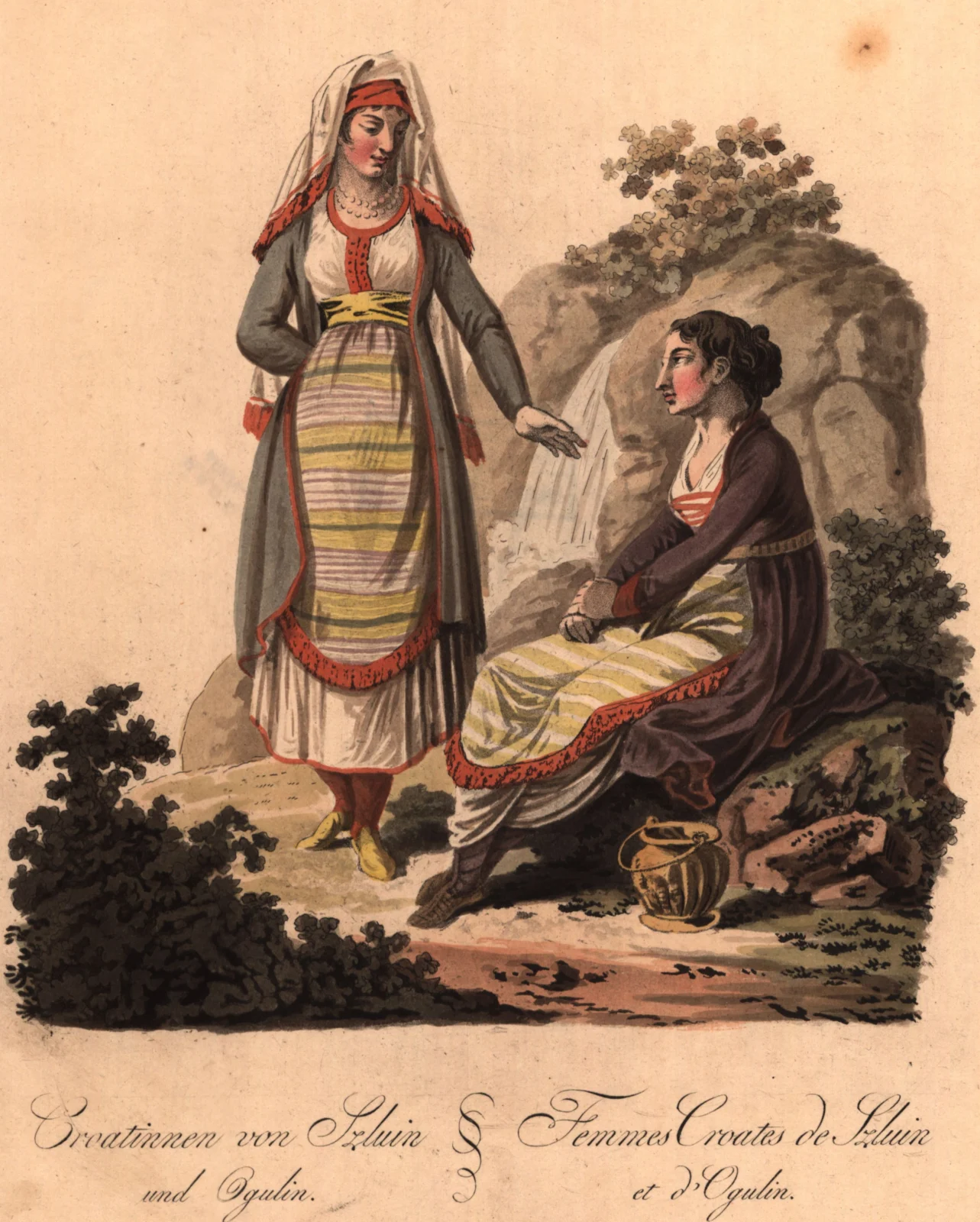
Croatian State Archives, HR-HAD-903. Inv. No. 1041. Representation of young Croatian girls from Slunj and Ogulin
The premodern population fought with a range of various diseases which endangered its survival and which today are either eradicated or pose no special threat. It is enough to mention the notorious plague, which killed entire communities with its repeated returning, leaving a trail of (half) empty villages and towns and permanently traumatized survivors. Alongside the frightening plague, other dangerous diseases lay waste, which today attack (seasonally) as well, but modern medicine treats them routinely. Once the flu, chicken pocks and pneumonia presented a large existential risk and the chances of surviving them were shockingly low. Such health conditions were present in many of our areas even in the years immediately following the Second World War, meaning until very recently. Modern (public) healthcare has protected us, but simultaneously blinded us as well. Not only do we not remember such horrible times of suffering, we have a hard time even imagining it. Therefore, modern people are shocked when they hear or read about the magnitude of former mortality from diseases, which we nowadays treat with the usual medicine or short-term sick-leave.
However, there is one disease that used to cause great fear and is therefore deeply embedded in the memory of society – rabies. Not only was this disease most often deadly, but it was frequently transferred by infected wild dogs in dramatic attacks on people. Other diseases were spread silently, but there was nothing hidden in the attack of a rabid dog. That pandemonium caused great fear amongst people and presented a big public health problem in the 18th and 19th century. Anyway, rabies is almost eradicated nowadays (at least when it comes to dogs), but it still remains a deadly disease if it does not get treated on time.
This text speaks of one such case. At the end of April 1850, the assistant doctor of the Slunj Frontier Regiment Franz Wild vaccinated 168 children in the area of the Lađevac Company during a day or two and was preparing to do the same in the Blagaj Company area. It is not specified for which disease this vaccination was done, but the vaccination coincided with an incident. Namely, on the day when the Lađevac Company vaccination started, 27 April 1850, in the village of Cvitović, a potentially rabid dog bit a twelve-year-old girl on her right forearm. Unfortunately, the name of the child was not recorded. The assistant doctor Wild examined the attacked girl and established that there was only a contusion without an open wound, but he still did the usual treatment – scarification, meaning small incision of the skin and prophylaxis.
From the report that he sent on that day from Veljun, we get an impression that he was optimistic about that girl’s chances of recovery. Was that hope justified or not, it is impossible to say. Even though 172 years have passed since that event, I believe that all readers hope that the girl recovered. However, we know that the Company was ordered, because of the work overload of doctors, that the unlucky child should be transferred to the Regiment hospital and put under the care of a parent or relative. The potentially rabid dog, if it had not already been killed, should be put under the supervision of doctors and reports about the whole case should be sent to the superior military forces after fourteen days. The competent authorities also requested an explanation for why they were notified of the event on 6 May. What happened later, we do not know – the archival sources either do not exist anymore or have not yet been found. The question is how much documentation was created in this case, because it is not about great historic events, battles or famous people, but a little human being, whose existence most often stayed unwritten, unsung and sunk into oblivion. Let this short text be a little memorial to this nameless multitude of people, creating the enormous mosaic of the past of Slunj and Frontier area.
Zagreb, 18 August 2025